A3, Phase I, Vatva GIDC Ahmedabad, Gujarat|GST: 24AAKPP6075E1ZL

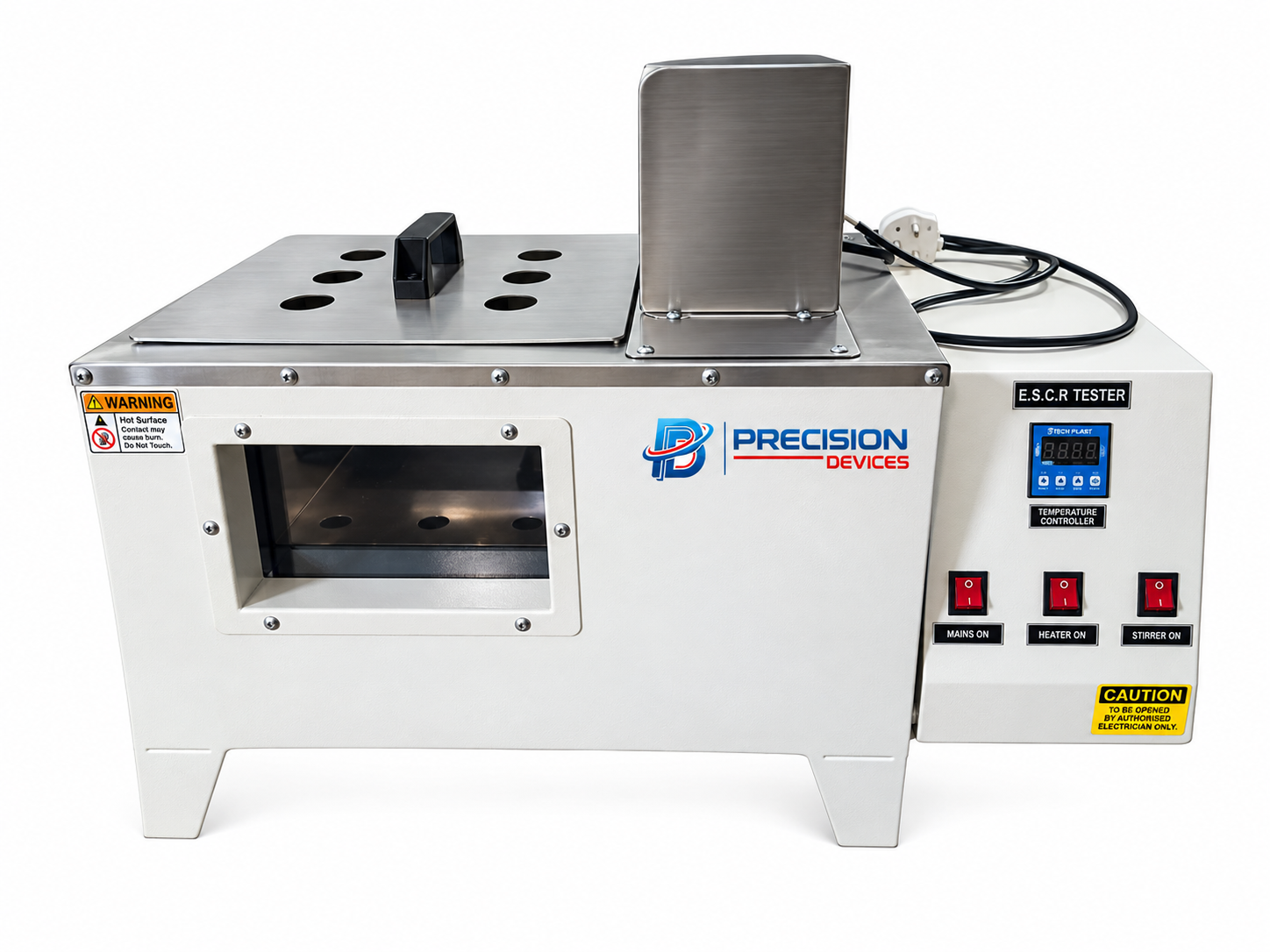
The ESCR Apparatus evaluates how well plastics resist cracking when exposed to mechanical stress and chemicals at the same time, a key measure of long-term performance for polyethylene and other thermoplastics.
Applicable Industries
Our engineering team typically responds within 24 hours.
The ESCR (Environmental Stress Cracking Resistance) Apparatus is a laboratory testing instrument designed to evaluate how well plastics resist cracking when exposed to mechanical stress and a chemical environment at the same time. Specimens are held under stress in a controlled test medium and observed for crack formation, giving a reliable measure of long-term performance for thermoplastics such as polyethylene.
| Test Method | Environmental Stress Cracking Resistance Test |
|---|---|
| Test Material | Thermoplastics, Primarily Polyethylene |
| Test Principle | Stressed Specimen Exposed to Chemical Environment |
| Test Evaluation | Crack Formation and Time to Failure |
| Specimen Mounting | Standardized Specimen Holders |
| Test Environment | Controlled Temperature Bath |
| Control System | Digital Monitoring and Control |
| Test Configuration | Laboratory-Scale ESCR Testing |
The apparatus is used to evaluate the stress cracking resistance of polyethylene and other thermoplastics, and to compare the performance of different resin grades.
It supports testing of bottles, containers, and closures that are exposed to detergents, oils, and other chemicals while under stress during use.
The instrument can be used to assess plastic pipes, fittings, and profiles where long-term resistance to cracking in service is important.
It helps compare resin grades, additives, and compound formulations by their stress cracking behavior.
The apparatus is suitable for material development, batch-to-batch consistency checks, product evaluation, and routine quality control testing.